The Housing crisis
To be on the Council’s Housing list you need to be legally homeless, live in overcrowded or very bad conditions, need to move because of a disability or medical reason, need to move to care for a relative, or be leaving care or the armed forces.
Despite this, of the 21,000, that’s families not people, on Bristol City Council’s list, half will never get a Council home. The rest will wait years. Eighteen hundred families are in emergency accommodation. That means one hotel room for mum, dad and the children. It means a teenager sitting on the toilet to do her homework, because there is nowhere else. That’s no way to bring up children.
But it’s only the tip of a very large iceberg. There are thousands of single people “sofa surfing”. Thousands more live in fear of eviction or daren’t complain to the landlord because they couldn’t find another flat to rent. The cost of renting has soared by 9.2% in the last year.
The Building Societies Association reports that first time buyers are facing the toughest conditions in 70 years. They need two good incomes and help from the “bank of mum and dad”, usually about £25,000.
When my father married my mother in 1949 he was living at Ashton Court. No, not in the big house. He was working for the army and the accommodation provided was a tented camp in the grounds. When they bought their first home, in 1952, they borrowed the deposit from family.
Why is it worse after all these years? It doesn’t have to be. In Japan they have tens of thousands of empty homes. In Sweden it’s normal to have a second home in the country because there was a surplus of homes due to late industrialisation. In this country housing is provided by “the market”. And the market’s job is to make profit.
It’s not society’s job to provide a home for everyone. But I do believe we should provide a safety net for those who suffer misfortune. All my life, (73 years) politicians have been promising to build more houses. Yet if politicians had built all the houses they’ve promised in my lifetime, we could house the population of China!
What is my solution?
We need to treat this as the emergency it is!
If you have received a section 21 eviction notice you need a home next month. We must start providing 10,000 homes a year. How?
Look at this picture of a new car park at Southmead Hospital.
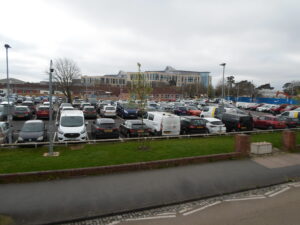
It’s publicly owned land. There was a building there before, so it’s a brownfield site. Look at this building on stilts.
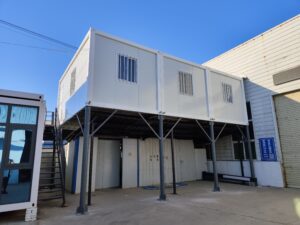
Why can’t they be put on part of the car park? A prefabricated building like this costs about £2,000. Fitting it out with plumbing and electrics and installing it would add more. But much less than traditional building costs and much quicker to put up. Several such units should provide an affordable flat for a young couple or a home for a desperate family.
There are hundreds of car parks where this could be done without affecting the operation of the car park Of course the supermarket or business owning the carpark would expect rent for its use. Others have suggested this. Why no action?
Where would the money come from? Michael Gove, the Minister for Housing, returned £1.9 bn budgeted for 2022-3 because he was unable to find housing projects to invest it in. I wrote to him asking how to apply for some of the money He didn’t reply. I was sent two pages of tory party propaganda. You can read the letters https://bishopstonbarry.uk/gove-letters/ The point is; the money is available.
There is something very seriously wrong with our planning department in Bristol. A local builder told me that applications to build houses have not even had a planning officer assigned after a year. He’s only building a few houses at a time, but no work can be done until he gets planning permission. Meanwhile permission is being granted for 28 storey tower blocks of student flats. Why? Could the difference be money? Are student flats more profitable because they pay no Council tax?
Consider Filton airfield. 8,000 feet by 91 yards wide, of concrete 2 feet deep. We could have put 2,200 three-bedroom prefabricated homes on it. These can be bought from china for under £10,000 and don’t need the skilled tradesmen to put up as traditional homes do. Yet it’s been empty for 12 years. It’s an absolute disgrace.
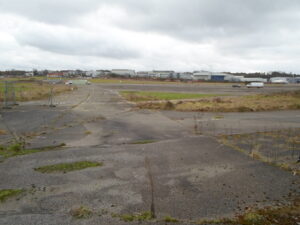
It’s worth considering the history of Filton airfield. At the end of the Second World War there was a plan to build a luxury airliner called the Brabazon. It wasn’t a commercial success. But to build it the runway had to be extended and the aircraft assembly hall, usually known as the Brabazon hanger, built. That cost £5¼ million of taxpayer’s money. Today that would be about £170 million.
In March 1992 the Government sold its interest in the airfield to BAe Systems for £14.05 million. The airfield closed at the end of 2012. Despite a profit of £1.6 million in the last year, BAe insisted the airfield wasn’t worth running. They applied for and got planning permission to build houses on it and then sold it to a Malaysian company called YTL.
Who benefits? The ordinary citizens, or BAe, YTL and South Gloucestershire Council? The boundary between Bristol and South Glos runs down the edge of the runway. So the homes are in South Glos and help meet their target for new homes, and they will get the Council tax. But the people who move in will use many of the services in Bristol.
There are many sites in Bristol where prefabricated homes could be put up as a temporary measure. Why aren’t we doing it?
How to provide 20,000 flats in Bristol at a stroke!
All we have to do is reduce the demand for student accommodation. Bristol University has about 20,000 students and UWE has 28,000 most of whom live in student flats or houses in multiple occupation. But how many of them need to be in Bristol? Some parts of courses are practical and can’t be learnt from a book or video. Medical students learning anatomy spend six months cutting up a cadaver for example.
But examine the structure of courses and you will find that most have a large amount of private study. 50% is common and 75% not unusual. Supposing courses were redesigned so that students could remain at home and only stay near the campus when they really needed to be there? This would free up a massive amount of housing currently occupied by students.
There is nothing new in this. The Open University has taught 2 million students at a distance in the last 50 years. It is now the largest University in the country with 170,000 students. Traditional Universities will not like changing. But it was forced upon them by Covid 19. Cambridge made all its lectures virtual until the summer of 2021
The average age in the building trade is 58. Builders cannot get the recruits they need and the polish plumbers have gone home. There is no way we can build the new homes we need traditionally.
It’s time to act!