Renewable energy from the Severn Estuary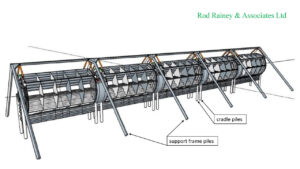
The last attempt to generate green energy from the river Severn foundered because it would have destroyed the mudflats on which 85,000 birds rely. One million members of the RSPB meant that it was a non-starter.
A Professor of engineering, Rod Rainey, has produced a design that preserves the mudflats. It is also cheaper to build than an equivalent amount of gas fired generating capacity. It appears to tick all the boxes. However the Professor doesn’t do politics, he just does engineering. So I have been trying to promote his scheme.
Unfortunately I have not had any success. Politicians listen politely but do nothing. As climate change becomes ever more urgent I believe we need a feasibility study to find out if Prof. Rainey is correct.
Prof. Rainey’s design for a Tidal Generator in the Severn Estuary
The Severn estuary has the second highest rise and fall of tide in the world. For nearly 100 years, since 1925 in fact, people have been proposing that this huge flow of water could be used to generate electricity.
But there are problems, apart from the obvious one of cost. The tidal mudflats provide food for about 85,000 migrating birds and the RSPB has a million members. Anything that damages the environment will, understandably, attract huge opposition.
Rod Rainey, visiting Professor of Engineering at Southampton University, has designed a system that will generate electricity cost effectively without reducing the tidal range. If he’s right we could generate enough electricity to provide about 10% of the UK’s needs without producing CO2 and have a negligible effect on wildlife – whether finned or feathered.
Most tidal generators use propellers in a duct. Prof. Rainey proposes an older technology, the breast shot water wheel.

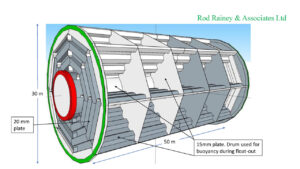
This is the system used in old fashioned water mills. The size of the wheels, 30 metres, means that fish and probably people (with a buoyancy aid) would pass through unharmed.
The really clever bit is that part way through the tidal cycle the generator is reversed and used as an electric motor to drive the wheel. Right now you’re probably thinking this is crackers. Why use electricity from the grid to push water up a tidal estuary? The answer is to ensure the tidal reach is as far as the unobstructed river so the mudflats aren’t reduced and the birds get their lunch.
Because the water pumped upstream flows back when the tide turns most of the energy is recovered. The actual loss in electricity generated is 4%. Genius! But how much would it cost and how does it compare to other methods of generation?
Prof Rainey suggests an 18 Kilometre generator from Nash point in Wales to Hurlestone point in Somerset.
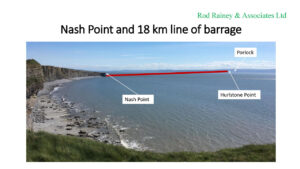
The sea bed at this point is level bare rock ideal for piled foundations. These would be drilled through a template and then the supporting cradles floated out and sunk in place. The water wheels are then floated out and sunk onto the cradles. For maintenance the procedure is reversed.
The estimated cost of construction is £3.8bn. The expected power generated per annum is 35TWh (Terawatt hours). Hinkley Point C is now costing £19.6bn and will produce 28TWh/year, if it runs flat out, which it may not. The Rainey barrage offers 25% more power for 20% of the cost. Interesting. But what are the alternatives?
The Swansea Lagoon project offers 530GWh/yr at a cost of £1.3bn and has, rightly, been rejected by the Government. The Carrington combined cycle gas turbine station opened March 2017 and cost £710m. Estimated Energy generated 3.779 Gwh/yr*. But this produces CO2. If carbon capture and storage were used the cost would be much higher.
Comparing the projected construction costs per TWh/yr we get:
Rainey system £108.57m
Carrington CCGT £187.88m
Hinkley point C £700m
Swansea Lagoon £2,452.8m (over 22 times the cost of the Rainey barrage)
This is a pretty compelling case financially, not to mention the environmental benefits. Although tidal power is not continuous it is predictable. We can work out the times of high tide for hundreds of years into the future. There is no reason why a barrage couldn’t generate power for a hundred years – much longer than conventional generators.
Given the urgent need to generate power without using fossil fuels this has got to be worth serious examination.
*actual figure confidential but load factor for CCGT in 2016 was 48.8% according to government figures
Comparison of different systems
The Rainey System
Projected cost £3.8bn
The power generated will vary with the state of the tide.
Average power generating capacity over a year will be 4GW
Total energy generated over a year 35 TWh/yr (4GW x 365 days x 24 hours equals 35,040 GWh/yr)
Hinkley point C
Projected cost £18bn (now risen to £19.6bn)
Power generating capacity 3.2GW
Energy generated over a year 28 TWh/yr (3.2GW x 365 days x 24 hours equals 28,032 GWh/yr) Assuming it operates flat out – Load factor for Nuclear in 2016 was 78.4% according to Government figures*.
The Rainey scheme would produce 25% more power for 20% of the cost.
Swansea Lagoons
Projected cost £1.3bn +
Power generating capacity 320 MW
Energy generated over a year 530 GWh (source: Tidal lagoon Power)
This is 1.5% of the energy for 34% of the cost of the barrage.
Generating 35 TWh using Swansea Lagoons would cost £85.85bn or 22.6 times as much as the barrage.
Carrington Gas fired power station
A modern combined cycle gas turbine station opened March 2017. cost £710m Power generating capacity 884MW
Estimated Energy generated over a year 3,779 GWh (actual figure confidential but load factor for CCGT in 2016 was 48.8% according to government figures* – 884 MW x 365 days x 24 hours x 48.8% equals 3.779 GWh)
35 TWh using this method would cost £6.6bn However it produces lots of CO2 . If carbon capture and storage is used the cost would be considerably higher.
Comparison of projected construction costs per TWh
Rainey system £108.57m
Hinkley point C £700m
Swansea Lagoon £2,452.8m
Carrington CCGT £187.88m
The Rainey system is suitable for use in many other locations. Although tidal power is not continuous it is predictable. We can work out the times of high tide for hundreds of years into the future.
*Digest of UK Energy statistics: Electricity Table 5.10
Illustrations showing the proposal are at www.rranda.co.uk where the slides used by Prof. Rainey when giving a talk about the system can be viewed.
Please note that the costs shown are now out of date but should still be useful for comparing different systems.
© Text Barry Cash 2023
© Pictures Rod Rainey and Associates

Leave A Comment